
A Spooktacular Indie RPG Bursting With Undead Heart
An Eight-Year Labor of Love Arrives on Consoles
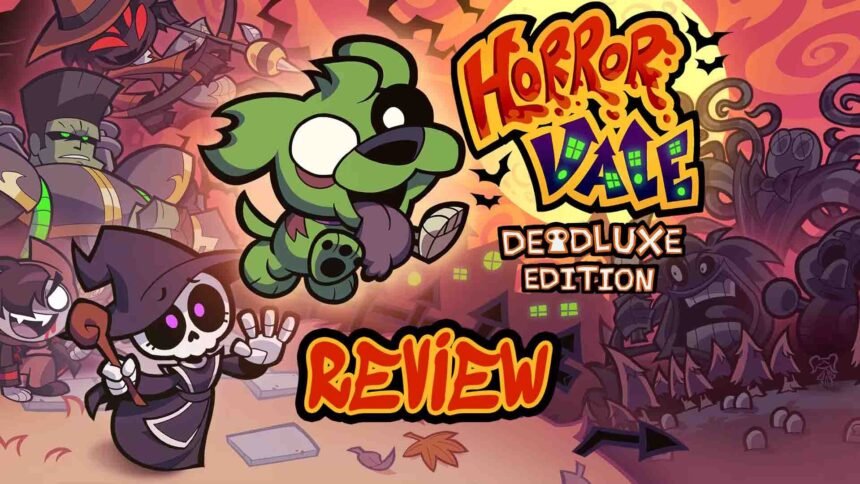
Every Halloween season brings a deluge of survival horror titles vying to terrify audiences with grotesque imagery and relentless psychological dread, yet very few games pause to celebrate the playful, trick-or-treat spirit of the holiday itself. Developed by independent studio BatWorks Software and published for consoles by Electric Airship, HorrorVale: Deadluxe Edition fills that niche with infectious enthusiasm. What began in October 2016 as a modest passion project between two friends—illustrator Dustin Andrews and composer Matthew Rock—graduated over eight years and thousands of development hours into a sprawling role-playing adventure. First released on PC in October 2024 before making its way to consoles in this expanded Deadluxe Edition, the title wears its inspirations proudly on its stitched-up sleeve. Channeling the offbeat humor of EarthBound, the eccentric character rosters of LISA: The Painful, and the subverted tropes of Undertale, all wrapped in a cartoon aesthetic reminiscent of The Nightmare Before Christmas, BatWorks Software has crafted a remarkably dense love letter to both classic turn-based RPGs and horror culture.
When I booted up HorrorVale: Deadluxe Edition on my PlayStation 5 Pro after receiving a review key, I was immediately struck by how far the game’s ambitions extend beyond its humble RPG Maker origins. Rather than relying on cheap jump scares or graphic gore, the adventure invited me into a vibrant, lived-in Underworld where the macabre is entirely mundane. Zombies are friendly next-door neighbors, reanimated monsters deliver the daily mail, and ghosts casually loiter in residential bathrooms. Beneath its lighthearted Saturday-morning-cartoon exterior, however, I discovered a surprisingly substantial role-playing system packed with tactical party-building, dozens of memorable companions, and a world mythos that consistently rewarded my curiosity.
Welcome to the Underworld: Story and Atmosphere
The narrative centers on Alice, a pint-sized skeleton witch whose everyday life at Skeleton Manor is upended when her beloved zombie dog, Scruffy, is abducted. The culprits are the “Creepies,” a bizarre and invasive new breed of monster that has suddenly begun terrorizing the otherwise peaceful valley of HorrorVale. What started in my playthrough as a straightforward neighborhood rescue mission quickly snowballed across a four-act campaign—complete with a prologue and late-game revelations—that sent Alice and her growing posse through spooky streets, eerie forests, gloomy basins, and treacherous candy mines.
Where HorrorVale immediately distinguished itself during my time in the Underworld is in its tonal dexterity and comedic timing. The writing serves as a grand celebration of horror across generations, seamlessly weaving tributes to classic Universal monsters and slasher icons together with modern internet creepypastas and meme culture. Crucially, I never felt that these pop-culture nods suffocated the core narrative; they operate as clever environmental flavor rather than replacing actual storytelling. As the acts progress, the plot takes several inventive turns that keep a 25-to-60-hour journey from feeling stagnant. One chapter pivots into a classic whodunit murder mystery inside Dracula Manor—complete with a clever twist regarding the initial victim, Pierre—while later chapters escalate into full-blown extraterrestrial conspiracies involving Dr. Flutenduten’s ethically dubious experiments, Mayor Fackenheem’s lightning research, and an alien cult known as the First Brotherhood led by Mother Keebra.
Even when the overarching plot swings toward cosmic absurdity in its final stretch, the emotional anchor remains grounded in the eccentric denizens of the Underworld. The Deadluxe Edition bolsters this narrative cohesion with revised hand-made artwork, new story cutscenes, and “Moment” conversations that allow optional party members to chime in during critical story beats rather than standing by as silent spectators. While I found a handful of late-game narrative leaps slightly less convincing than the tightly focused early acts, the sheer charisma of the dialogue effortlessly carried the story across the finish line.




Turn-Based Tricks and Treats: Combat and Party Building
Underneath its humorous dialogue, HorrorVale operates as a traditional turn-based RPG that refused to let me coast by on basic attacks alone. Across the campaign, my party crossed paths with over 500 mechanically distinct enemies, ranging from possessed household objects to grotesque boss monstrosities. Rather than bogging down dungeon crawls with invisible random battles, enemies roam visibly on the overworld map. Better still, once an overworld foe is defeated, it stays dead permanently. Because overworld items are one-time acquisitions and nothing can be stolen, this design choice eliminated tedious backtracking grind from my playthrough while turning every dungeon corridor into a deliberate resource-management puzzle where items and health had to be budgeted wisely between vendor visits.
Combat encounters demanded my active engagement with elemental weaknesses, status ailments, and monster biology. Casting a restorative healing spell on an undead zombie damages it rather than helping it, while ethereal ghosts require specialized items or spectral skills to banish effectively. In a refreshing departure from standard genre conventions, HorrorVale completely averts contractual boss immunity: every single boss in the game—including the final boss—is susceptible to status effects. Landing a well-timed burn, immobilization, or defense debuff during a grueling boss encounter felt genuinely rewarding and validated status-focused builds that many RPGs render obsolete in their second half.
The centerpiece of this tactical sandbox is the staggering roster of more than 30 recruitable party members. BatWorks Software smartly pairs this massive cast with a universal shared experience system, ensuring that benched companions level up at the exact same pace as the active party. Freed from the chore of level grinding newly acquired recruits, I constantly swapped my team compositions on the fly to experiment with wild mechanical gimmicks. Classic horror archetypes map naturally onto specialized RPG roles, such as sturdy Frankenstein’s Monster damage-sponges like Gwen, fast blood-stealing vampire rogues, and the spider archer Webs, who tips arrows with different insects for status effects and chugs drinks mid-battle to trade accuracy for a 25 percent damage boost. Other companions subvert standard ability economies entirely; the pumpkin-headed plant-undead Jack fuels heavy artillery skills like “Drive,” “Grenades,” and “Jack O’ Launcher” using actual Halloween candy alongside standard ability points, whereas the ravenous goblin clown Plum can devour 20 pieces of candy mid-fight to instantly replenish her own health and energy reserves.
That mechanical creativity extends even further into power-copying and transformation systems that kept late-game team building fresh. Mask Guy acts as a “Creepvoker,” using his video camera in battle to record Creepies and adopt their stats, elemental properties, and skills—with an anti-frustration vendor named Hood Dude selling recordings of any permanently defeated monsters I happened to miss. Later in Act 4, the summoner Henry joined my roster, channeling abilities directly from every major boss my party had defeated across the campaign. Meanwhile, characters like Kris build their entire combat loop around being possessed by her partner Tannherjar, and Jekyll can transform into “Chad,” a hulked-up powerhouse built for devastating physical strikes.
With over 30 companions vying for four active party slots, balance is understandably a bit uneven. I found a few recruits noticeably underwhelming compared to powerhouse staples like Beatrice, Juno, or Fluche, and the game is not always fully transparent about the exact math governing certain character abilities, status effects, or elemental interactions. Fortunately, the Deadluxe Edition incorporates a welcome State Tooltip toggle that helped me inspect active buffs and debuffs during combat, alongside a comprehensive Monsterpedia and a Quick Brew feature that streamlines potion crafting. While routine skirmishes occasionally gave way to sudden difficulty spikes during boss fights, the shared XP pool made reconfiguring my party after a defeat completely painless.
Exploring the Valley: Quests, Puzzles, and Console Quirks
Outside of battle, HorrorVale kept my playthrough lively through environmental puzzles, dungeon gimmicks, and 60 optional sidequests tracked in Alice’s diary. Rather than feeling like disposable filler, many of these side stories flesh out the personal struggles of Alice’s companions and reward the party with ultimate skills. Standout character arcs include Gwen confronting her callous creator in “Where We Belong” and Master Calhoun delivering a cathartic verbal takedown to the overbearing fathers of the wendigo-deer hybrid Willow and Flynt in “To Be Stronger”. Even when a quest forced me into a mutually exclusive choice, a clever shop run by Jiang in the local mall allowed me to purchase missed quest rewards later on, ensuring completionists are never locked out of unique gear.
Dungeon and quest design frequently steps outside standard turn-based templates to keep players on their toes. One memorable sequence channels Metal Gear Solid, tasking Alice with sneaking through a labyrinthine ventilation shaft to rescue police station survivors while evading a pursuing Creepy, while another sent my party hurtling down the newly sped-up minecart tracks of Gumdrop Gulch Mine. For dedicated completionists who conquer all 60 sidequests, track down every act’s hidden secret boss, and clear the main campaign, interacting with Alice’s bed unlocks the Dream Colosseum—an endgame gauntlet featuring scaled-up boss rematches with brand-new mechanics and turn-count leaderboards.
It was primarily during the non-combat movement sequences and sprawling map transitions that the game’s foundational engine showed a few seams during my playthrough. Navigating certain multi-screen areas can feel slightly cumbersome, and action-oriented minigames occasionally lacked sharp directional precision on a controller. Furthermore, while the majority of the puzzles hit a satisfying middle ground that broke up combat encounters nicely, two or three late-game brainteasers leaned toward the obtuse, and a handful of minor sidequests boiled down to simple back-and-forth conversations. None of these minor friction points ever derailed my enjoyment, however, largely because the surrounding world is such a joy to inhabit—and with BatWorks Software already teasing a future spin-off titled HorrorVale: Act M starring Mothman, it is easy to stay invested in this universe.
A massive share of that infectious atmosphere belongs to the extraordinary 170-track original soundtrack. Helmed by co-creator Matthew Rock and featuring guest contributions from legendary Banjo-Kazooie and Donkey Kong Country composer Grant Kirkhope, the score is a triumph of theatrical, Halloween-infused composition. From the infectious bounce of battle themes like “Spooky Swing” and “Creepy Swing” to the eerie charm of “Waltz-o-the-Wisp” and the boss track “Paranormal Lamptivity,” the music elevated every pixel-art backdrop and custom battle animation on my screen.
Verdict
HorrorVale: Deadluxe Edition is a testament to what passionate independent developers can achieve when given the time to let their creative vision snowball. BatWorks Software and Electric Airship have delivered an exceptionally generous RPG that oozes personality from every haunted pore. While the underlying RPG Maker framework introduces occasional stiffness during movement-based minigames, and the sheer volume of characters and mechanics can lead to moments of uneven balance or opacity, those minor blemishes pale beside the game’s boundless heart. Between its witty writing, smart quality-of-life features like shared party XP, and an unforgettable 170-track soundtrack, my time helping Alice rescue her zombie dog stands out as an essential treat for any fan of quirky, old-school role-playing games.