
Doubly Grimdark, Endlessly Addictive
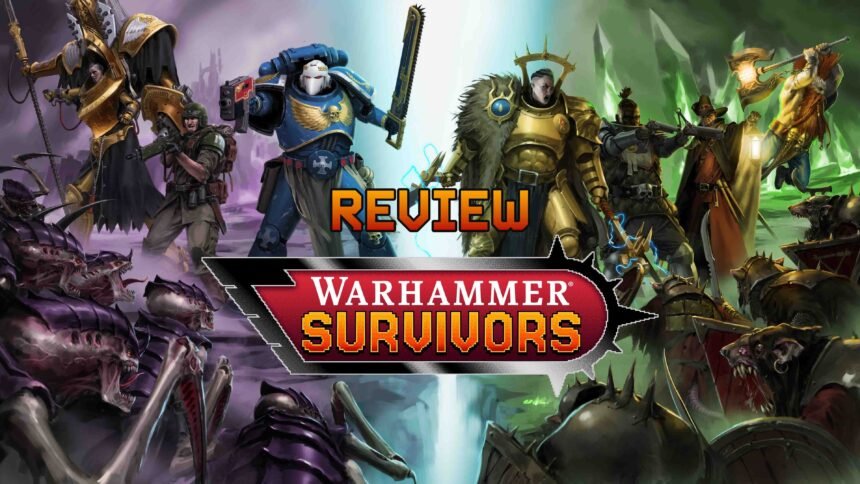
When developer and publisher Auroch Digital—the studio behind the wonderfully retro boomer-shooter Warhammer 40,000: Boltgun—announced it was teaming up with Vampire Survivors creator poncle and Games Workshop to build Warhammer Survivors, the crossover felt almost too obvious to fail. Few fictional settings in entertainment history lend themselves more naturally to the reverse bullet-hell genre than a universe defined by heroic champions making desperate last stands against millions of ravenous aliens, daemons, and rat-men. Having spent the past several days putting my review key through its paces on the PS5 Pro, I can confidently say that Auroch Digital’s reverence for the source material shines through on nearly every screen. For a budget launch price of just $7.99, this is an absurdly generous, time-devouring celebration of Games Workshop’s legacy, even if a punishing early-game grind and some rigid directional targeting mechanics keep it just shy of the genre’s absolute pinnacle.
At its core, Warhammer Survivors is built directly upon poncle’s genre-defining foundation, tasking you with surviving 25-minute stages against escalating tides of enemies while collecting experience skulls, opening elite treasure chests, and chaining together screen-melting weapon evolutions. Yet rather than settling for a quick cosmetic reskin, Auroch Digital has packed the release with two distinct games’ worth of content, a clever companion squad mechanic, and an infectious sense of humor that pokes fun at the real-world miniature painting hobby. It has a few rough edges in its initial balancing and control options that require patience to overcome, but once its progression loop sinks its teeth into you, putting the controller down for the night becomes a genuine test of willpower.
Story and Lore: A Love Letter to the Tabletop Hobby
If you are coming into Warhammer Survivors hoping for a cinematic narrative campaign or an original plot weaving its roster together, it is worth setting expectations early: there isn’t a traditional story mode here. Because the bullet-heaven genre prioritizes immediate, repeatable arcade action over dialogue and cutscenes, the game skips bespoke storytelling altogether. You won’t find lengthy lore codices explaining why an Ultramarine or a Stormcast Eternal has been dropped into a particular meatgrinder, which actually makes the experience remarkably welcoming if your knowledge of Warhammer starts and ends with knowing that Space Marines wear oversized pauldrons and Orks love shouting “WAAAGH!”.
Where the game lacks a scripted plot, however, it more than compensates with rich environmental theming and brilliant meta-commentary on the tabletop wargaming hobby itself. Right from the main menu, the presentation splits into two distinct branches: the grimdark, far-future sci-fi of Warhammer 40,000 and the high-fantasy Mortal Realms of Warhammer: Age of Sigmar. Every stage is anchored to a cohesive enemy faction rather than a random assortment of monsters. When you drop into the ruined Imperial Bastion or Death World Invasion in 40K, you are fending off coordinated Tyranid swarms led by Synapse creatures; when you venture into the claustrophobic corridors of the Gallowdark Space Hulk, you are wading through toxic Death Guard legions and Nurglings that litter the floor with poison-spewing chimneys; and on The Great Parch or Under-Empire in Age of Sigmar, endless waves of Skaven Clanrats and Globadiers scurry out of the dark.




What elevated my appreciation for the world-building from simple fan service to genuine delight is how Auroch Digital breaks the fourth wall to celebrate the physical craft of collecting and painting miniatures. Scattered across the battlefields and tied to specific combat milestones are official Citadel Paint Pots—such as Abaddon Black, Leadbelcher, Mephiston Red, Macragge Blue, and Agrax Earthshade. Collecting these paints allows you to “paint” and unlock new playable champions on the character select screen, including Space Marine 2 protagonist Lieutenant Demetrian Titus. The armory and upgrade menus are similarly steeped in hobbyist terminology, referencing your “Bit Box” and letting you equip passive items like Liquid Green Stuff, modeling Glue, a Tape Measure to expand your attack area, a Tactical Rock, and issues of White Dwarf magazine to boost experience gains. You can even hurl giant, exploding red D6 Dice across the battlefield—whose damage literally scales with the number rolled on the die face—or spill pots of Nuln Oil that evolve with an Hourglass into Mordant Earth, coating the floor in devastating black washes that slow and dissolve everything in sight. Topping it all off is an unlockable Hobby Table stage shared by both universes, which shrinks your heroes down to miniature scale to battle across a fan’s actual crafting desk.
Two Universes, One Massive Package
The sheer volume of content packed into this release is easily one of its strongest selling points. Splitting the game between Warhammer 40,000 and Age of Sigmar isn’t just a menu toggle; each branch operates almost like a standalone title with its own distinct roster, weapon pool, stage progression, and musical identity—shifting from grungy, heavy-metal riffs in the 41st Millennium to sweeping orchestral fantasy scores in the Mortal Realms. Across both campaigns, there are 43 playable champions (22 in Warhammer 40,000 and 21 in Age of Sigmar), 79 total weapons (including 21 evolution recipes in 40K and 18 standard recipes plus a special morph in Age of Sigmar), 22 passive items, and 12 stages to conquer.
In the Warhammer 40,000 campaign, you begin with Boltgun hero Malum Caedo and gradually assemble an all-star roster of Imperial and Space Marine legends. Unlocking characters goes far beyond simply spending gold; you will rescue stranded heroes like Trooper Bartosz Kozlowski, Commissar Sebastian Yarrick, Chapter Master Marneus Calgar, and Saint Celestine directly off the battlefield by defeating the elite squads surrounding them. Every champion alters the rhythm of a run. Playing as Knight-Commander Pask, for instance, puts you at the helm of a hulking Leman Russ Battle Tank that physically crushes smaller fodder beneath its treads while calling down orbital voidship strikes from above. Meanwhile, the Age of Sigmar side starts you with Stormcast assassin Neave Blacktalon and opens up a wildly diverse fantasy cast—from Lorai, Child of the Abyss, who shrouds herself in a slowing Nebulous Sea-Fog aura, to iconic slayer Gotrek Gurnisson, Yndrasta the Celestial Spear, and Kharadron Overlords sky-pirates like Drekki Flynt.
While the two universes track their stage unlocks and character rosters separately, Auroch Digital smartly bridges them through cross-universe meta-progression. Spending gold coins earned during runs on permanent stat Enhancements—such as movement speed, cooldown reduction, base damage, and skull pickup radius—initially applies to the universe you are currently playing. However, fully maxing out an upgrade track unlocks a universal bonus rank that permanently buffs your entire roster across both Warhammer 40,000 and Age of Sigmar, gently encouraging you to bounce back and forth between sci-fi corridors and fantasy plains rather than ignoring half the package.
Combat, Followers, and the Targeting Dilemma
Moment-to-moment gameplay adheres closely to the tried-and-true survivor formula, where your weapons fire on cooldown and your primary responsibility on the controller is guiding your champion’s movement and positioning. Yet Warhammer Survivors introduces a standout mechanical wrinkle that gives its combat a distinct tactical identity: the Follower system. Because Games Workshop’s lore has strict rules regarding which heroes can wield certain faction weapons, picking up an armament in the level-up screen that your current character cannot canonically use—or rescuing an allied NPC mid-mission—summons a secondary companion onto the field to wield it for you.
These Followers trail behind you in a loose formation as you weave through the horde, firing their weapons from their own physical coordinates on the screen rather than from your hero’s center mass. By the final ten minutes of a strong run, it is thrilling to watch your solo hero blossom into a full-blown warband—charging through a Space Hulk accompanied by a Cadian Guardsman, an Ultramarine, a Living Saint, a mechanical-biting K9 Mastiff, and a battle tank. It forces you to think differently about your movement geometry, since your companions drag behind you like the tail of a kite, though I did find that having five Followers firing rockets, lasers, and sweeping greatswords inside cramped indoor rooms can make the screen visually chaotic, even with the developers’ situational transparency system helping to fade friendly sprites.
Where the combat controls left me somewhat frustrated, however, is in how the game handles weapon targeting and aiming direction. Playing with a controller, your movement is handled entirely with the analog stick—and while the right stick is active, it simply mirrors the left stick to move your character rather than letting you aim independently. That wouldn’t be an issue if weapons automatically locked onto approaching threats, and to be fair, a handful of weapons in the arsenal do: Trooper Kozlowski’s Lasgun (and its boss-melting Meltagun evolution), the Boltstorm Pistol, and Armand Callis’s Brace of Pistols all automatically fire at the nearest enemy, while Chief Librarian Mephiston’s Smite zaps the toughest nearby target.
The problem is that a huge portion of the early arsenal—especially on the Warhammer 40,000 side—is strictly locked to the direction your character is facing. Malum Caedo’s starting Chainsword only slashes horizontally, and the iconic Boltgun (along with its evolved Heavy Bolter), Saint Celestine’s Ardent Blade, and the Fusil-Cannon only fire in the exact direction you are moving. In a genre where survival relies on kiting backward away from overwhelming swarms, forcing you to turn and walk directly toward a lethal wall of Tyranids or Orks just to line up your shots feels counterintuitive. Until you stack enough “Extra Attack” upgrades to make directional weapons cover your rear or unlock nearest-enemy weapons, several starting loadouts feel unnecessarily clunky. I genuinely missed having an auto-targeting option in the settings menu; allowing directional firearms like the Boltgun to automatically snap to the closest target would have made early runs feel vastly more responsive.
Pacing, Extremis Bosses, and the Early Grind
That targeting friction feeds into the most noticeable hurdle in Warhammer Survivors: a steep, unforgiving opening few hours. Unlike Vampire Survivors, where you start snowballing into an unstoppable god of destruction within your very first few runs, Warhammer Survivors makes you work hard for every inch of progress early on. Basic enemies do not always drop experience skulls when slain, base movement speed and pickup radius start out quite low, and mid-run sub-bosses—highlighted by a neon-green outline, such as the 15-minute Tyranid Carnifex or Death Guard commander Typhus—act as massive bullet sponges. As noted by reviewer coverage, while the 15-minute boss in Vampire Survivors has 200 HP per character level, the 15-minute Carnifex in Warhammer Survivors scales at 2,500 HP per character level, absorbing an immense amount of punishment while you desperately kite around environmental obstacles.
Stage hazards and faction mechanics also demand much sharper tactical awareness than the genre norm. On Ork Stronghold, the greenskins periodically trigger a psychic “WAAAGH!” that supercharges enemy waves while Bomb Squigs and a giant conjured foot crash down from the sky. On indoor maps like Gallowdark and Imperial Shipyard, walls and doors physically block your character and certain projectiles while allowing spectral or swarming enemies through, requiring you to use doorway chokepoints, knockback auras like Shield of Faith, or vertical sky-strikes like the Whirlwind Battery to avoid getting cornered.
Surviving all the way to the 25-minute mark brings you face-to-face with a stage’s towering Extremis Boss—such as the Norn Emissary, Great Unclean One, or Ghazghkull Thraka in 40K, and Vizzik Skour, Trugg the Troggoth King, or Skarbrand in Age of Sigmar. Here, Auroch Digital introduces an ambitious puzzle mechanic: each Extremis Boss is effectively invincible and will execute an instant-kill attack unless you have crafted its specific “Bane” weapon evolution during that run. Taking down Ghazghkull Thraka, for example, requires rescuing Commissar Yarrick, pairing his Power Klaw with a fully maxed Da Lucky Stikk passive, and evolving it into the Bale Eye laser implant before minute 25; similarly, felling the Norn Emissary requires evolving Marneus Calgar’s Power Fist with a maxed Codex Astartes into the Gauntlets of Ultramar. It is a clever way to incentivize exploring the entire unlock tree across different stages, though the game does a somewhat opaque job of explaining this requirement the first time a boss effortlessly wipes out your 25-minute run.
Fortunately, once you push past the initial three-to-four-hour grind and invest gold into permanent Enhancements, the pacing opens up dramatically, delivering that glorious, screen-clearing dopamine rush the genre is famous for. Even better, Auroch Digital has already demonstrated commendable post-launch transparency: the studio has publicly acknowledged player feedback regarding spongey enemy health pools, making core gameplay balance its immediate priority alongside a generous roadmap of four free content updates running through Q2 2027 that will add new characters, weapons, evolutions, and cross-save support. The only other notable omission at launch is a co-op mode, as the experience is strictly single-player for now, though the Follower system at least captures the spirit of fighting alongside a squad.
Verdict
Warhammer Survivors doesn’t reinvent the bullet-heaven wheel, nor does it try to hide its DNA as a direct spiritual cousin to Vampire Survivors. What it does deliver is an exceptionally crafted, content-packed tribute to both Warhammer 40,000 and Age of Sigmar that bursts with personality, clever tabletop hobbyist humor, and dozens of hours of replayability. The opening hours can feel a bit grueling due to inflated sub-boss health pools, and the lack of an auto-targeting option for facing-locked weapons like the Boltgun makes early kiting harder than it needs to be. Yet once your meta-upgrades kick in and you are leading a makeshift squad of Space Marines, Guardsmen, and battle tanks through a sea of exploding dice and Nuln Oil, the “just one more run” magic is undeniable. At $7.99, it is an easy recommendation for Warhammer veterans and genre fans alike.