
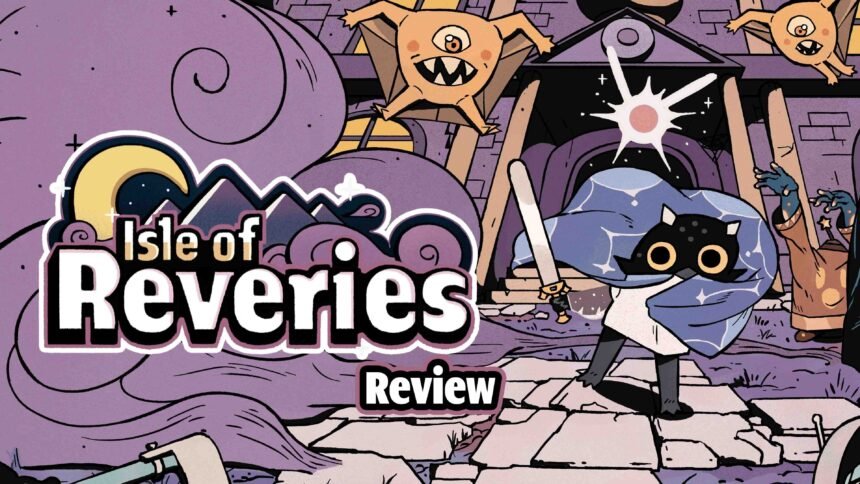
The revival of the top-down action-adventure genre has seen a staggering number of entries over the past decade, driven largely by a collective nostalgia for the handheld consoles of the late 1990s. Yet, few titles commit to their historical inspirations as devoutly—and as creatively—as Isle of Reveries. Developed by desertcucco and published by Electric Airship, this puzzle-centric adventure channels the spirit of classic Game Boy Color adventures while introducing complex, modern spatial mechanics that set it apart from being a mere homage. Evaluated for this critique via a pre-release review key provided for the PlayStation 5 Pro, the title shines brilliantly on modern hardware. However, the core appeal of the experience lies entirely in its masterful gameplay loop, evocative puzzle design, and poignant storytelling, allowing the game’s artistic merits to take center stage.
A Pilgrimage of Hope and Melancholy
The narrative of Isle of Reveries follows Lief, a young, anthropomorphic owl embarking on a desperate pilgrimage to the titular landmass. The premise rests on a local legend promising that anyone who reaches the heart of the island will have a single wish granted. For Lief, the motivation is deeply personal and emotionally resonant: the resurrection of a deceased younger brother. However, this promise of salvation comes with a morbid caveat, as it is widely known in the game’s lore that none who venture to the forsaken isle ever return.
This juxtaposition of charming, colorful pixel art with noticeably dark thematic undertones works beautifully to establish the game’s atmosphere. The story opens on a bittersweet note, where the stars in the night sky are likened to the souls of those who perished on their own pilgrimages, comforting the living with their glow while serving as a grim reminder of the journey’s stakes. Throughout the roughly fifteen-hour main campaign, players encounter a caravan of hodgepodge wanderers and lost souls. While the overarching narrative skeleton is somewhat derivative of classic adventure tropes, the somber twists and the surprisingly emotional weight of the dialogue give the journey a distinct, melancholic flavor. The non-player characters scattered across the overworld—such as the eccentric Mr. Akedo, the easily frightened Vangie, and the enigmatic Ralph—provide necessary levity, breaking up the tragedy of the island with quirky side quests and memorable interactions.
Exploration and the Density of the Overworld
Beyond the immediate narrative, the overworld of Isle of Reveries is divided into eight diverse biomes, ranging from the lush expanses of the Verdant Valley to the chilling peaks of the Snowcloaked Mine. The map design is highly dense, ensuring that almost every screen holds a secret, a buried treasure, or a hidden pathway. The sense of progression is palpable; completing dungeons and earning new tools organically unlocks previously inaccessible routes, rewarding thorough exploration with extra health pieces and gameplay-altering trinkets.



However, this density occasionally acts as a double-edged sword. The labyrinthine structure of the world, combined with narrow corridors and limited fast-travel shortcuts in the early hours, can make navigation feel slightly claustrophobic. Navigating the map can sometimes result in tedious backtracking, especially when a wrong turn leads down a long, one-way sequence of screens. Fortunately, the developer remedies this in the mid-game through specific items like the Seashell Ukulele, which introduces a much-needed fast-travel system to alleviate the travel friction.
Masterclass Dungeon Design
Where Isle of Reveries truly excels, and where it firmly justifies its existence in a crowded genre, is within its dungeon design. The title demands a high level of spatial reasoning, offering seven distinct, meticulously crafted dungeons that serve as the undeniable highlight of the experience.
These labyrinths operate less as a collection of isolated combat rooms and more as massive, interconnected puzzle boxes. The introductory Pilgrim’s Sanctum effectively teaches the player the fundamental rules of the world, but the training wheels are quickly removed. By the time the player reaches the Wyrm’s Remains, the game demands the manipulation of complex pipe puzzles while dynamically swapping the entire dungeon’s environment between water, ice, and lava themes. Later, the Timelocked Villa forces players to engage with intricate temporal mechanics, accessing different areas of the dungeon by shifting time itself. The puzzle complexity creates a clear, satisfying throughline where early mechanics build into larger, mind-bending challenges, showcasing the developer’s deep understanding of top-down level design.
The Magic of Duplication and Ingenious Tools
The defining feature of this gameplay loop is a highly innovative duplication mechanic tied to Lief’s fairy companion. Rather than relying solely on traditional block-pushing, the fairy possesses the magic to copy specific environmental objects and spawn them elsewhere on the map. This system opens up a staggering amount of puzzle-solving potential, allowing players to carry the solution from one room to an entirely different floor of the dungeon. It is layered tastefully with a robust inventory of tools, preventing the duplication mechanic from rendering other items obsolete.
As progress is made, the arsenal expands to include wildly imaginative tools. The Claw’ncher acts as a hookshot-style device that doubles as a traversal aid and a combat utility, while the Rift Wand allows Lief to swap places with objects across the room, fundamentally altering how the player views gaps and barriers. Other classic mainstays, such as the lantern and traditional sword, are integrated seamlessly alongside more exotic finds like Roc’s Hammer and the Draco’launcher. The boss encounters capping off these dungeons operate as brilliant skill checks, seamlessly blending these acquired tools with the duplication puzzle mechanics learned in the preceding rooms.
The Friction of Combat and Platforming
To maintain an objective and realistic perspective, it is necessary to highlight areas where the title stumbles, ensuring that future updates or sequels might refine these edges. While the puzzle design is nothing short of stellar, the combat encounters and platforming segments occasionally disrupt the game’s otherwise excellent pacing.
Magic and tool usage in Isle of Reveries are governed by a cooldown-based meter rather than consumable drops. Because certain mid-to-late game enemies can only be damaged after being stunned by specific tools, combat frequently devolves into a waiting game. Lief’s standard sword attack has a relatively short reach compared to the sweeping strikes and large health pools of later adversaries, leaving players to dodge incoming attacks endlessly while waiting for the cooldown meter to recharge. This system makes combat feel more tedious than challenging, slightly dampening the thrill of exploration. Furthermore, the penalty for dying during a boss fight often involves a frustratingly long run-back from the start of the dungeon, an archaic design choice that feels out of place given the modern conveniences found elsewhere in the game.
Similarly, the inclusion of a dedicated jump button adds welcome verticality to the classic top-down perspective, but the execution feels slightly unrefined. The jump distance is quite short, barely clearing one-tile gaps, which makes precision platforming sequences feel needlessly punishing. The protagonist also exhibits a tendency to snap awkwardly to moving platforms. Enemy knockback during these platforming sections can lead to cheap fall deaths, although optional trinkets discovered in the overworld can thankfully be equipped to mitigate some of the fall damage. While these flaws are noticeable and momentarily frustrating, they are ultimately overshadowed by the sheer brilliance of the overarching puzzle mechanics.
World Building, Community Forging, and Co-op
To offset the intensity of the dungeons, the game introduces a highly engaging community-building feature. As wandering souls and anthropomorphic characters are rescued from the island’s perils—such as the aforementioned Mr. Akedo or the duo Quaritz and Bantern—they can be relocated to a customizable township. Players can construct various buildings to accommodate these NPCs, which in turn unlocks additional narrative threads, specialized juice-making side quests, and valuable upgrades. While this settlement management system is not overwhelmingly deep, it provides a cozy, relaxing distraction between intense dungeon crawls and adds a tangible sense of progression to Lief’s heroic efforts to reverse the island’s curse.
Additionally, the game offers a supplementary cooperative mode. While the primary campaign is a strictly single-player journey, the developer has included two separate, dedicated multiplayer stages that can be tackled with a friend via local co-op. These stages serve as a delightful bonus, allowing players to test their combined puzzle-solving acumen in environments specifically designed for two participants, adding an extra layer of replayability to the overall package.
An Audiovisual Triumph
From an aesthetic standpoint, developer desertcucco has perfectly captured the visual constraints and specific charms of the handheld era. The pixel art is highly charismatic, utilizing a limited color palette to create striking, readable environments that evoke profound nostalgia. The visual presentation is entirely authentic to its inspirations while remaining incredibly smooth, vibrant, and responsive on the PlayStation 5 Pro hardware, proving that strong art direction consistently triumphs over raw graphical fidelity.
Equally impressive is the audio design. The atmospheric chiptune soundtrack is breathtaking, immediately setting the tone from the title screen. The music swells with epic, driving beats during boss encounters and transitions to haunting, melancholic melodies when exploring the quiet remains of the forsaken island. Very few tracks miss the mark, and the soundtrack easily stands as one of the most remarkable aspects of the entire production, ensuring that the melodies of Isle of Reveries linger in the mind long after the console is powered off.
Final Verdict
Isle of Reveries is a triumphant love letter to the handheld action-adventure games of yesteryear. It succeeds not by merely mimicking the classics, but by introducing a highly innovative duplication mechanic that fundamentally redefines how top-down puzzles are solved. The intricately crafted dungeons, the emotionally resonant narrative surrounding Lief’s pilgrimage, and the phenomenal chiptune soundtrack make this journey well worth the effort for any fan of the genre.
While the cooldown-based combat pacing and the slightly clunky platforming introduce minor frustrations that hold the game back from absolute perfection, these elements are not severe enough to derail the overarching experience. The developer has crafted a world dripping with atmosphere and respect for its audience’s intelligence. It is an incredibly easy recommendation for puzzle enthusiasts and retro-adventure fans alike, proving that the classic top-down formula still holds immense, untapped potential.