
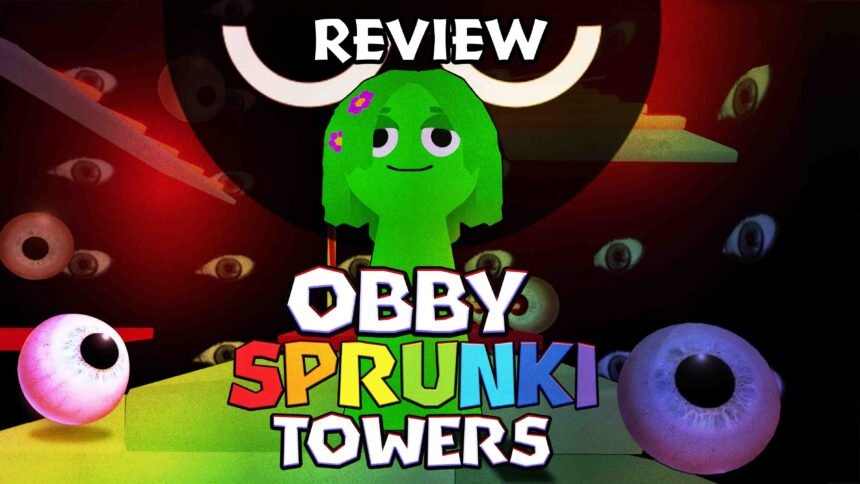
The transition from a viral, community-driven internet phenomenon into a fully localized, standalone console experience is an evolutionary leap that few indie projects manage to survive unscathed. Yet, Obby Sprunki Towers manages to bridge this ambitious gap with a surprising level of mechanical confidence and atmospheric flair. Developed by Big Way and published by BIG WAY LLC, this 3D platformer takes the quirky, rhythm-based lore of the popular Sprunki universe and reconstructs it into a vertically demanding obstacle course. For the purpose of this analysis, a pre-release review key was provided by the publisher, and the entire campaign was evaluated on the PlayStation 5 Pro. The experience on this hardware proved to be highly responsive, placing the focus entirely on the game’s narrative descent and the precision of its gameplay, rather than being hindered by any performance hurdles or control latency. For a title that demands absolute concentration and rhythm, this level of stability is a fundamental necessity.
Positioned as a budget-friendly release at an accessible $4.99, expectations regarding the sheer volume of content must naturally be kept in check. However, what Obby Sprunki Towers might lack in sprawling, hundred-hour open worlds, it more than compensates for with exceedingly tight mechanics, a compelling aesthetic shift, and a surprisingly dark narrative undertone that respects the established lore of its franchise. This review will examine how the vertical climb holds up under scrutiny, focusing on the story elements and the gameplay loop that define this idiosyncratic platformer.
From Rhythm Roots to Architectural Dread
To understand the narrative weight of Obby Sprunki Towers, one must first acknowledge its roots. The Sprunki franchise originally gained traction as an eccentric, music-mixing fan project with a massive online following, celebrated for its unique character designs and interactive beats. This console iteration bravely shifts genres from a purely musical sandbox into an action-platformer with pronounced horror elements.
The narrative revolves around the antagonist known as Black, a malevolent, shape-shifting entity responsible for plunging the previously harmonious and colorful Sprunki world into absolute chaos. Black has captured the lovable cast of Sprunki friends—characters that series veterans will instantly recognize, such as Oren, Pinki, and Durple—and imprisoned them at the apex of several sinister, towering structures. The player steps into the shoes of a surviving Sprunki, tasked with ascending these monolithic obbies (obstacle courses) to mount a desperate rescue mission.
What makes the story engaging is the complex, almost paradoxical characterization of Black. The antagonist is not merely a generic, brooding figure; according to the game’s established community lore, Black is a violent entity who embodies the very concepts of dread and fear, yet possesses bizarrely comedic flaws. Black is noted to occasionally break character, acting almost like a kind grandfather before becoming easily distracted by simple pleasures, such as an insatiable craving for desserts like cake. This juxtaposition of a world-ending, corrupting force who utilizes gooey tentacles to ensnare victims, but who might also forget to finish off a captive because of a sudden distraction, gives the narrative a distinct, slightly surreal identity that sets it apart from traditional platforming villains.




The story does not rely on long, exposition-heavy cinematic cutscenes. Instead, the narrative unfolds environmentally. As the protagonist climbs higher, the cheerful, vibrant origins of the Sprunki universe slowly give way to something deeply oppressive and terrifying. This environmental storytelling effectively communicates the stakes, visually representing Black’s corrupting influence the closer the player gets to the summit. It is an effective way to translate the infamous “Horror Mode” of the original music game into a tangible, explorable 3D space.
Precision Platforming and Progression
Pacing and control are the lifeblood of any 3D platformer, and Obby Sprunki Towers demonstrates a profound understanding of this fundamental rule. The gameplay loop is built entirely around the concept of an obstacle course where every single jump carries significant weight. The development team at Big Way has engineered a physics and movement system that is incredibly fair but highly demanding. When a jump is missed and the character plummets, the resulting fall feels like a direct consequence of player miscalculation rather than artificial randomness, clunky hitboxes, or cheap game design.
The campaign is structured around several distinct towers, each functioning as a separate trial with its own unique mood and mechanics. The brilliance of the level design lies in its gradual escalation. The early stages, fittingly tied to the “Easy Start” and “Easy Win” progression milestones, introduce the basic mechanics in bright, almost cheerful environments that serve as a gentle tutorial. The platforming here is highly rhythmic, requiring the player to time jumps in tandem with the game’s stylish, pulsating soundtrack. Trophies are awarded for simple milestones, such as executing 100 and 500 jumps, which encourages players to get comfortable with the movement physics early on.
However, as the ascent continues into the medium and hard tiers, the game introduces diverse mechanics that change drastically from level to level. Platforms begin to move erratically, environmental hazards linked to Black’s dark influence appear, and the margin for error shrinks significantly. The rhythmic element becomes less about bopping along to a catchy beat and more about pure survival, forcing a state of absolute, unblinking concentration.
This platforming gauntlet is occasionally punctuated by boss encounters, referred to in the game’s progression tracking as “dark challengers”. These encounters serve as the climaxes for the easy, medium, and hard towers. Rather than forcing traditional action-combat mechanics into a game built around jumping, these boss fights expertly require the player to outmaneuver the challenger while continuing to navigate treacherous vertical platforming. It is an intense test of the skills learned in the preceding levels, ensuring that the difficulty curve feels earned and deeply satisfying rather than arbitrarily frustrating.
The Audiovisual Descent
A platformer is only as immersive as the world it asks the player to navigate, and the artistic direction of Obby Sprunki Towers is undoubtedly one of its strongest assets. The game executes a masterful audiovisual bait-and-switch. It begins with the familiar, vibrant color palettes and upbeat visuals that fans of the original Sprunki universe expect. But as the altitude increases, the environments gradually become darker, culminating in anxious, horror-infused sections that feel genuinely oppressive.
The transition from a colorful indie aesthetic to psychological horror is handled with impressive subtlety. The background music, which starts as upbeat and stylishly rhythmic, slowly morphs into something dissonant and creepy, perfectly syncing with the visual deterioration of the towers. This auditory descent into madness mirrors the corruption caused by Black, creating a tense but undeniably captivating atmosphere. For a game centered around the relatively simple act of jumping from platform to platform, the oppressive mood makes the physical act of climbing feel incredibly weighty. The player is constantly urged by the game’s marketing and internal narrative to “climb higher, don’t look back,” and the claustrophobic sound design heavily reinforces this sense of pursuit.
Diplomatic Critiques: Pacing and Accessibility
To maintain a balanced and realistic perspective—and to provide fair consumer advice—it is necessary to address the areas where Obby Sprunki Towers occasionally stumbles. While the core gameplay is mechanically tight and devoid of injustice, the overall experience is undeniably brief. The game features a modest list of just twelve progression milestones, and an experienced platforming veteran can conquer all levels and challenges, ultimately achieving the “Ultimate Run,” in a single afternoon of dedicated play. The low barrier to completion means the game respects the player’s time, but those looking for a sprawling, multi-week platforming epic will need to adjust their expectations accordingly. Given the highly affordable $4.99 price tag, this short runtime is completely acceptable and represents good value, but it remains a bite-sized experience rather than a marathon.
Furthermore, while the transition from level to level introduces exciting new mechanics, the early stages border on being a bit too simplistic. The “Easy Start” tower serves as a necessary on-ramp for players unaccustomed to 3D platformers, but it lacks the creative teeth and mechanical complexity found in the final act of the game. The horror elements, which are easily the game’s most unique and compelling selling point, take a bit too long to fully materialize. If the oppressive atmosphere and the threat of the dark challengers had been woven in slightly earlier, the pacing of the emotional arc would have felt more consistent.
Lastly, the narrative, while charming in its dark quirks, assumes a fair bit of prior knowledge regarding the Sprunki universe. Players who are unfamiliar with the community lore surrounding characters like Wenda, Simon, or the true nature of Black’s “Horror Mode” might find some of the visual references, character designs, and overarching stakes a bit confusing. The game operates on the assumption that the player is already invested in saving these specific friends, offering very little foundational exposition for absolute newcomers. However, for established fans of the franchise, this lack of hand-holding will likely be seen as a respectful nod to their dedication to the lore.
Final Verdict
Obby Sprunki Towers is a surprisingly competent and mechanically sound 3D platformer that punches above its budget-friendly weight class. Big Way has successfully achieved the difficult task of transforming a 2D musical sandbox concept into a tense, vertical nightmare on modern consoles. By stripping away random mechanics and focusing purely on rhythm, intense concentration, and demanding jumps, the title offers a deeply satisfying gameplay loop.
The seamless environmental transition from a bright, cheerful world into a dark, horror-tinged gauntlet keeps the simple act of climbing feeling fresh and urgent. While the runtime is admittedly short and the early levels lean toward the simplistic side, the complete lack of cheap deaths and the perfectly calibrated difficulty curve make the final ascent highly rewarding. It is a focused, premium platforming experience that prioritizes quality and responsiveness over bloated filler content.
For fans of the Sprunki lore, this is an essential, beautifully twisted chapter in the universe that successfully recontextualizes the characters they love. For platforming enthusiasts looking for a cheap, polished, and atmospheric weekend challenge, it is a leap well worth taking.